As a language scientist and linguistic anthropologist, I'm interested in the strategies humans and models deploy to imbue signs with sense, and the shared cultural, sociological, and cognitive priors that allow them to do so.
- June 2026: Co-edited the special issue The notion of authenticity in hybrid human/AI productions for AI-Linguistica, bringing together interdisciplinary contributions on language, authenticity, and generative AI.
- June 2026: Published Habeas Corpus: An Exploration of Authentic Embodiment and Ecology in a French Contrastive Corpus, proposing an Embodiment Scale for analysing human, hybrid, and LLM-generated texts.
- April 2026: Awarded the French National Qualification (Qualification aux fonctions de Maître de conférences, CNU Section 7 – Language Sciences), granting eligibility to apply for permanent academic positions in French universities.
- January 2026: I'm the proud host of a new podcast Sign(e)s where each episode my guest chooses a sign, symbol, or icon, and we unpack it together. Do listen in, I'm taking a summer break, but there are already nine episodes to catch up on.
My Ph.D thesis supervised by Julien Longhi and defended in December 2023, proposes a typology of 6 usages of non-standard minuscules in digitally mediated communication, in particular the non-standard 1SG. It draws on a wide interdisciplinary and theoretical base, applying notions such as prosody, indexicality, enregisterment, and iconicity, and combining them with elements of cognitive theory and social psychology to provide a usage profile for each of the six taxa. Jury member and examiner Julie Neveux (Sorbonne) remarked "la thèse soumise par Sophia Burnett est bienvenue car elle contribue à ce domaine scientifique en plein développement"/"The thesis submitted by Sophia Burnett is a welcome contribution to this rapidly developing scientific field". And Jürgen Spitzmüller (Vienna) wrote "The thesis is a very valuable contribution to grapholinguistics, the sociolinguistics of writing and research into digitally mediated (meta-)discourse."
Since my PhD I have been a Teaching and Research Associate (French Public Servant), first at the Université de Lorraine & IDEA laboratory, and since 1st September 2025, l'Université de Toulouse. My research this year is hosted by LAIRDIL laboratory. I am also an associate member of Laboratoire AGORA, CY Cergy Paris.
Research profile
-
Disciplinary anchors:
Linguistic anthropology; computer-mediated discourse analysis; usage-based linguistics (UBL); embodied linguistics; ecolinguistics; cognition; semiotics.
Preferred approaches:
A mixed-methods approach combining quantitative, experimental, and introspective methods for the analysis of situated corpora, with triangulation integrating formal and theoretical linguistics.
Specialist themes:
communicative attenuation; identity; stance; reflexive function; embodiment; social semiotics; morphology; graphophonology; enregisterment; metapragmatics.
Previously
-
Classically trained, I was a professional dancer for fifteen years before joining la Sorbonne Paris 1 and the Conservatoire Européen d'Ecriture Audiovisuelle to study French screenwriting. I then worked as a script doctor and translator for film, TV, and theatre, and as a localization specialist for advertising. I have published a couple of novels, one of which, a historical fiction titled A Useless Mouth has been studied by International section lycéen.nes in France.
Also
-
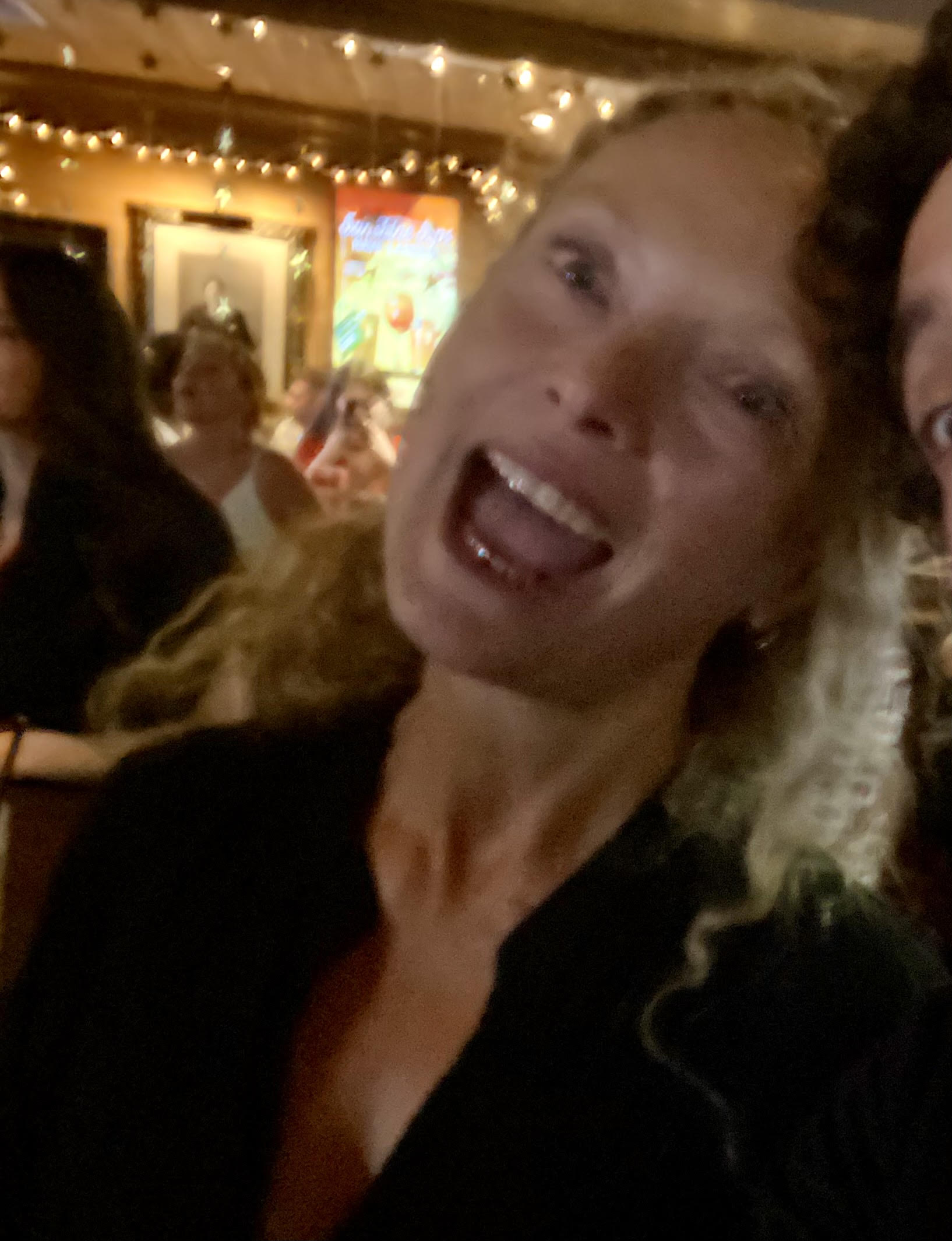
My unserious picture was taken in August at an Irish Pub in Edinburgh during a rousing rendition of The Proclaimers.